Types of Caviar Explained: Beluga,
Osetra, Sevruga, and Kaluga

Lover of subtle differences and clean classifications
Kaluga Caviar and Other Major Types Explained

The most recognized types of caviar are defined by the species of sturgeon they come from. Kaluga, Beluga, Osetra, and Sevruga are among the names you’ll encounter most often.
All four are sturgeon caviar, but they differ in bead size, firmness, and flavor. Those differences are useful when you’re comparing jars because “black caviar” covers a fairly wide range of textures and flavor profiles.
Quick Takeaway
Beluga is known for very large, delicate eggs and a mild, creamy flavor. Kaluga also has large beads, but they are firmer and have a more noticeable pop. Osetra tends to be medium-to-large, firm, and nutty, while Sevruga has smaller beads and a stronger briny character.
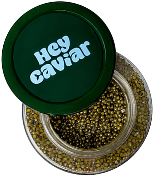
Why the Sturgeon Species Shapes the Caviar Experience
Caviar isn’t flavored to create variety.

Much of the variation between caviars begins with the sturgeon itself.
Different species produce eggs of different sizes and membrane firmness, which affects how the roe feels when you eat it. The species also influences the flavor and the way salinity comes across on the palate.
Processing still matters. A careful cure and proper handling help preserve the characteristics of the roe, while too much salt or poor storage can make those differences harder to notice.
For that reason, species gives you a useful idea of what a caviar should taste and feel like, but the condition of the particular jar still matters.
Beluga Caviar
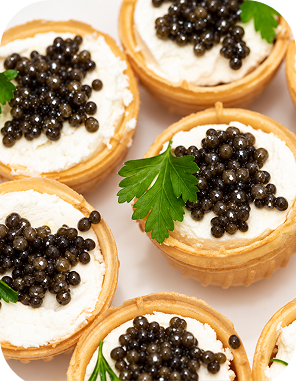
Beluga is historically associated with very large eggs, a delicate membrane, and a softer texture.
Instead of a pronounced pop, the beads tend to yield gently against the tongue. The flavor is generally mild, rich, and creamy rather than sharply briny.
Availability varies because trade in Beluga sturgeon and its caviar is subject to regulatory restrictions. When people describe the classic Beluga profile, they are usually referring to the combination of large beads, delicate texture, and restrained flavor.
Its softer membrane also means the roe requires careful handling to keep the beads intact.
Quick Takeaway
Beluga is known for very large beads with a soft, delicate texture and mild, creamy flavor. The eggs yield gently on the palate rather than giving the firmer pop associated with Kaluga.
Kaluga Caviar
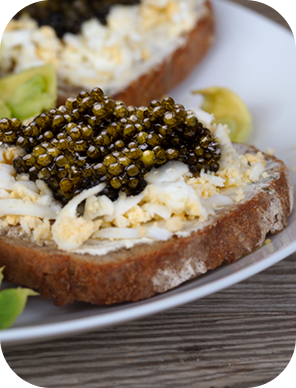
Kaluga caviar has become a common choice among people looking for large beads with more firmness than traditional Beluga.
The eggs are typically large, with a defined membrane that gives them a noticeable pop. The flavor tends to be smooth and buttery, with enough salinity to season the roe without covering its natural character.
Color can range from dark gray and charcoal to lighter shades, so color alone isn’t particularly useful for identifying it. The combination of bead size and firmness tells you considerably more.
Kaluga is the caviar we chose to focus on at Hey Caviar. Our Grade A Kaluga has the large, firm beads and clean release that make this type easy to recognize, especially if you’re tasting premium caviar for the first time.
 Osetra Caviar
 Osetra Caviar
Osetra, sometimes spelled Ossetra, generally produces medium-to-large beads with a firmer texture than Beluga.
Its flavor is often described as nutty and complex, sometimes with buttery or mineral notes. The exact profile varies between producers and individual batches, but the combination of firm beads and a more distinctive flavor is a useful way to recognize Osetra.
If you taste it alongside Beluga, the difference in texture is usually easier to identify than any difference in color.
Sevruga Caviar
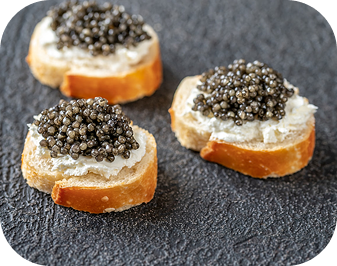
Sevruga generally produces the smallest beads of these four well-known caviar types.
The flavor tends to be more pronounced and briny, while the texture is usually softer and more delicate than firmer varieties such as Kaluga or Osetra.
That stronger flavor is part of Sevruga’s character. Someone who enjoys a more noticeable oceanic or briny profile may prefer it to a milder caviar.
How to Tell Caviar Types Apart
You don’t need to see the jar to make an educated guess about the caviar in front of you. Look at the size of the beads, then pay attention to their texture and flavor as you taste the caviar.
- Beluga: very large, delicate beads with a soft membrane. They release easily on the tongue rather than giving a firm pop. The flavor is rich, creamy, and mild.
- Kaluga: large beads similar to Beluga, but noticeably firmer. The eggs have a clean pop, followed by a buttery flavor and a long, smooth finish.
- Osetra: medium to large, firmer beads. A useful clue is the flavor, which is typically more complex and nutty, often with buttery or mineral notes.
- Sevruga: smaller beads and a more intense flavor. It is usually saltier, brinier, and more ocean-forward than Beluga, Kaluga, or Osetra.
A useful shorthand is: Beluga is large and delicate, Kaluga is large and firm, Osetra is firm and nutty, and Sevruga is small and intense.
Color can help, but don’t rely on it. Different types of black caviar can overlap in color, and individual batches vary. Size gives you the first clue, but texture and flavor are what help narrow it down.
Why Kaluga Caviar Has Become So Prominent

Kaluga has become widely available in the premium caviar market because it combines several characteristics that appeal to both new and experienced caviar eaters.
The beads are large enough to give the visual and textural impact people often associate with premium caviar, while their firmer membrane produces a noticeable pop. Its buttery flavor and controlled salinity also make it easy to eat plain or with simple pairings.
Farm-raised Kaluga has become an important part of modern caviar production as aquaculture has expanded. Farming gives producers more control over breeding, growing conditions, harvest timing, and traceability while reducing reliance on wild sturgeon populations.
We chose Grade A Kaluga for Hey Caviar because we like that particular combination of size, firmness, and flavor. Put a spoonful next to a softer caviar and the difference is easy to feel without needing a tasting vocabulary or a scorecard.


Start With a Type You’ll
Recognize Next Time
Descriptions are useful up to a point. Once you taste two caviars with different bead sizes and textures, terms like “firm,” “delicate,” and “pronounced pop” become much easier to understand.
Our Grade A Kaluga gives you a clear reference point: large beads, a firm texture, a clean pop, and a smooth, buttery flavor. Try the first spoonful plain and pay attention to how the beads feel before they release. Then put the next spoonful on a potato chip, blini, or a little crème fraîche if you want.
The next time Osetra, Beluga, Sevruga, or another Kaluga appears on a menu, you’ll have something real to compare it with.
Try Our Grade A Kaluga.